
Why Your AC Keeps Tripping the Breaker in a Lubbock Summer
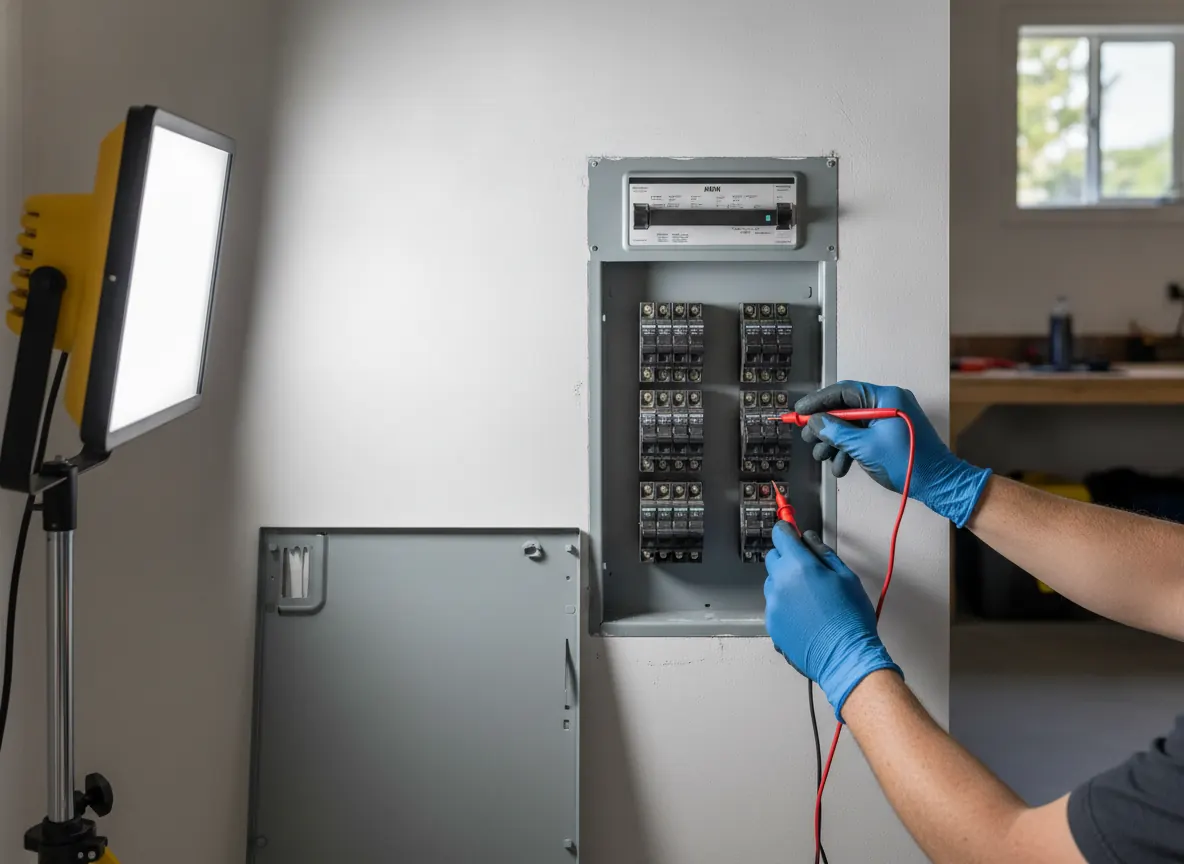
On a 100°F afternoon in Lubbock, TX, the air conditioner runs almost nonstop, and that is when a weak part tends to show itself. If the AC breaker keeps tripping, the breaker is doing its job: it shuts off a circuit that is drawing more current than it should, or that has a fault. The useful question is why, and whether the fix belongs to an HVAC technician, an electrician, or both.
Lubbock averages about 92 days a year at 90°F or hotter and about 13 days at 100°F or hotter (NOAA 1991–2020 normals, Lubbock airport). The all-time record is 114°F on June 27, 1994 (National Weather Service). Long run hours are hard on compressors, capacitors and breakers alike.
General guidance, not a diagnosis. This post explains common patterns so you can describe the problem clearly and call the right trade. It is not a repair guide. Do not remove the panel cover, open the outdoor disconnect, or swap a breaker yourself. If you smell burning, see smoke or scorch marks, or the breaker or panel is hot to the touch, leave it off and get help. If there is smoke or fire, call 911.
Why does my AC keep tripping the breaker?
An AC system has two big electrical loads: the outdoor condenser (compressor and fan) and the indoor air handler or furnace blower. Each usually has its own breaker. A trip can come from the equipment drawing too much current, or from the wiring and breaker that feed it. These are the common causes, grouped by who usually handles them.
| Possible cause | What you might notice | Usually handled by |
|---|---|---|
| Dirty filter or clogged outdoor coil | Weak airflow, long run times, trips late on hot afternoons | Homeowner (filter) or HVAC technician (coil) |
| Failing start/run capacitor | Humming or clicking at the outdoor unit, fan slow or not spinning, trips at startup | HVAC technician |
| Hard-starting or shorted compressor | Loud start, lights dim when it kicks on, trips within seconds | HVAC technician |
| Condenser fan motor problem | Fan not turning while the compressor runs | HVAC technician |
| Worn or weak breaker | Trips at normal load, breaker warm, no equipment fault found | Electrician |
| Loose or corroded connection at the breaker or outdoor disconnect | Buzzing, warmth, discoloration, intermittent trips | Electrician |
| Breaker or wire size doesn't match the unit | New or replaced AC unit on an older circuit | Electrician (often flagged by the HVAC tech) |
| Damaged wiring between the panel and the condenser | Trips immediately on reset, even with the thermostat off | Electrician |
Is it an HVAC problem or an electrical problem?
Often the first call is to an HVAC technician, because most AC trips trace back to the equipment. A few patterns point more toward the electrical side. These are general rules of thumb, not a substitute for testing.
- Trips at startup with a hum or a click: often a capacitor or compressor issue. Start with HVAC.
- Trips after running a while on the hottest afternoons: could be airflow, a dirty coil, a struggling compressor, or a breaker that has weakened with heat and age. HVAC first, electrician if the equipment checks out.
- Trips the instant you reset it, even with the thermostat off: suggests a short in the wiring or the unit. Leave it off and call. An electrician can test the circuit; an HVAC tech can test the unit.
- The breaker or panel is warm, buzzing, or shows scorch marks: an electrician's job. Leave it off.
- Other breakers trip too, or lights flicker across the house: points to the panel or service, not the AC. See the emergency electrician guide for what to do first.
- Half the house or the whole street is dark: that may be the utility. Check the LP&L outage map before calling anyone.
The outdoor unit has a nameplate that lists a minimum circuit ampacity and a maximum overcurrent protection rating. A technician can compare that to the breaker and wire in your panel. If a newer, larger unit went in on an older circuit, the mismatch can show up as nuisance trips. Never put in a bigger breaker to stop the trips; the breaker size has to match the wire and the equipment.
What you can safely check before calling
Check the thermostat and filter
Make sure the thermostat is set to cool and the filter is not clogged. A dirty filter makes the system work harder.
Look at the outdoor unit from outside
Clear debris, weeds or blown dust from around the condenser so it can breathe. Do not open the unit or the disconnect box.
Reset once, then wait
Turn the thermostat off, reset the breaker one time, wait several minutes, then turn cooling back on. If it trips again, leave it off. Repeated resets can damage equipment.
Write down the pattern
Note when it trips (at startup, after an hour, only in late afternoon), any sounds, and the age of the unit and the house. That saves time on the service call.
Why Lubbock summers expose weak circuits
Heat and run time are part of it. Housing age is the other part. About 28% of Lubbock homes were built in the 1960s and 1970s (ACS 2020–24 5-year estimates), in areas like Rush, Tech Terrace and much of central Lubbock. Many of those homes have had their AC replaced more than once, sometimes on the original circuit and panel. A worn breaker or a loose connection that tolerates a mild spring may not hold up in July. Newer homes in Southwest Lubbock and Kelsey Park are not immune; a breaker can fail early, and connections can loosen over time.
If the issue is the breaker or panel, a contractor may suggest replacing the breaker or, for an older or damaged panel, a panel replacement or upgrade. Ask why, and ask for the reasoning in writing.
A note on power delivery: Lubbock Power & Light still delivers power, handles outages and owns the meter; your retail provider handles your bill (since 2024). If the problem is on the utility side, the utility handles it. In Wolfforth, Shallowater, Slaton and Idalou, check your bill to see whether Xcel Energy or South Plains Electric Cooperative serves you.
What does an electrician visit cost?
Published national cost guides put a service call at about $100–$200, often covering the first hour (HomeGuide), or $176–$327 for a service visit (Fixr). After-hours or emergency work runs about $150–$200 per hour plus a call-out fee (HomeGuide). These are estimates, not quotes. The Lubbock electrician cost guide lists more ranges and a calculator. If a breaker replacement or new circuit needs a City of Lubbock permit, the minimum electrical permit fee is $50 (City fee schedule, FY 2023–24).
Questions to ask before work starts
- What is your TECL contractor license number? Check it at tdlr.texas.gov/LicenseSearch.
- Is there a trip or diagnostic fee, and does it apply to the repair?
- What is your after-hours rate if this happens on a weekend evening?
- Can I get a written, itemized quote before work starts?
- Does this job need a permit, and who pulls it?
- If you find an HVAC problem, will you tell me so I can call the right trade?
Texas requires electrical contractors to be licensed by TDLR and to carry at least $300,000 per occurrence in liability insurance. Texas requires it; verify it. Our guide to the Texas electrician license lookup walks through the search.
If the electrical side looks like the problem, you can request a free quote. Describe what trips and when, and independent licensed electricians serving Lubbock can reply. Lubbock Electrician Pros is a free quote service, not an electrician.
Frequently asked questions
Why does my AC trip the breaker only on the hottest afternoons?
On very hot days the system runs longer and the compressor works harder, so it draws more current. A dirty filter or coil, a weak capacitor, or a breaker that has worn with age can push it over the limit. Start with an HVAC check; if the equipment tests fine, have an electrician check the breaker and connections.
Is it safe to keep resetting the AC breaker?
Reset it once with the thermostat off, wait a few minutes, then try again. If it trips a second time, leave it off. Repeated resets can damage the compressor or hide a wiring fault. If you smell burning or the breaker is hot, leave it off and call for help; if there is smoke or fire, call 911.
Should I call an HVAC company or an electrician when the AC trips the breaker?
Most AC trips trace back to the equipment, so an HVAC technician is often the first call. Call an electrician when the breaker or panel is warm or buzzing, the breaker trips instantly even with the AC off, other circuits trip too, or a new AC unit went in on an older circuit.
Can a bad breaker cause the AC to trip?
Yes. Breakers can weaken with age and heat and trip below their rating. A licensed electrician can test the breaker and check the connections. Do not replace it yourself, and never install a larger breaker than the wire and equipment allow.